If you’re a gardener and have ever lived somewhere where bears weren’t a real issue, chances are you’ve attempted to build a compost pile. In bear territory, though, everything is a little different. Maybe you’ve still tried and had issues, or maybe you’ve written the idea off completely. And, yes, an open compost pile in the middle of the property might as well be advertised as a bear buffet.
The Tension Between Bears and People
No doubt, conflicts between people and bears have increased in recent years. This may drive some people to give up on composting. The unfortunate reality of that outcome is that we’re missing an opportunity to create a resource usable on our own properties while also decreasing the amount of waste headed to the landfill. For people who are composting, albeit carelessly, the outcome can be even worse. Nuisance bears become an issue and end up getting relocated or put down due to repeat offenses. Without getting into the ever-political feeling give and take here, just know that composting in bear territory is a solvable design problem.
What I Built
Most compost bins on the market, and even plans widely available online that claim to be "pest resistant" are targeting things like rats, raccoons, and other smaller animals. But bears are smart, dexterous, and large. Following guidelines for a bear-proof trash caddy posted by the Massachusetts Division of Fisheries and Wildlife, I developed my own bear proof bin. The notable features are gaps all less than 1/2 or 1/4" where possible, corners that are carriage bolted through 4x4 posts, and a bin that is ultimately held in the ground with concrete footers. Two heavy duty hasps close the bin on either side. Even if a bear smelled my compost and climbed around, I don’t think they’re going to do much damage to this monolith. Each board or piece of hardware is easily individually replaced though, so this bin should serve me for years to come.
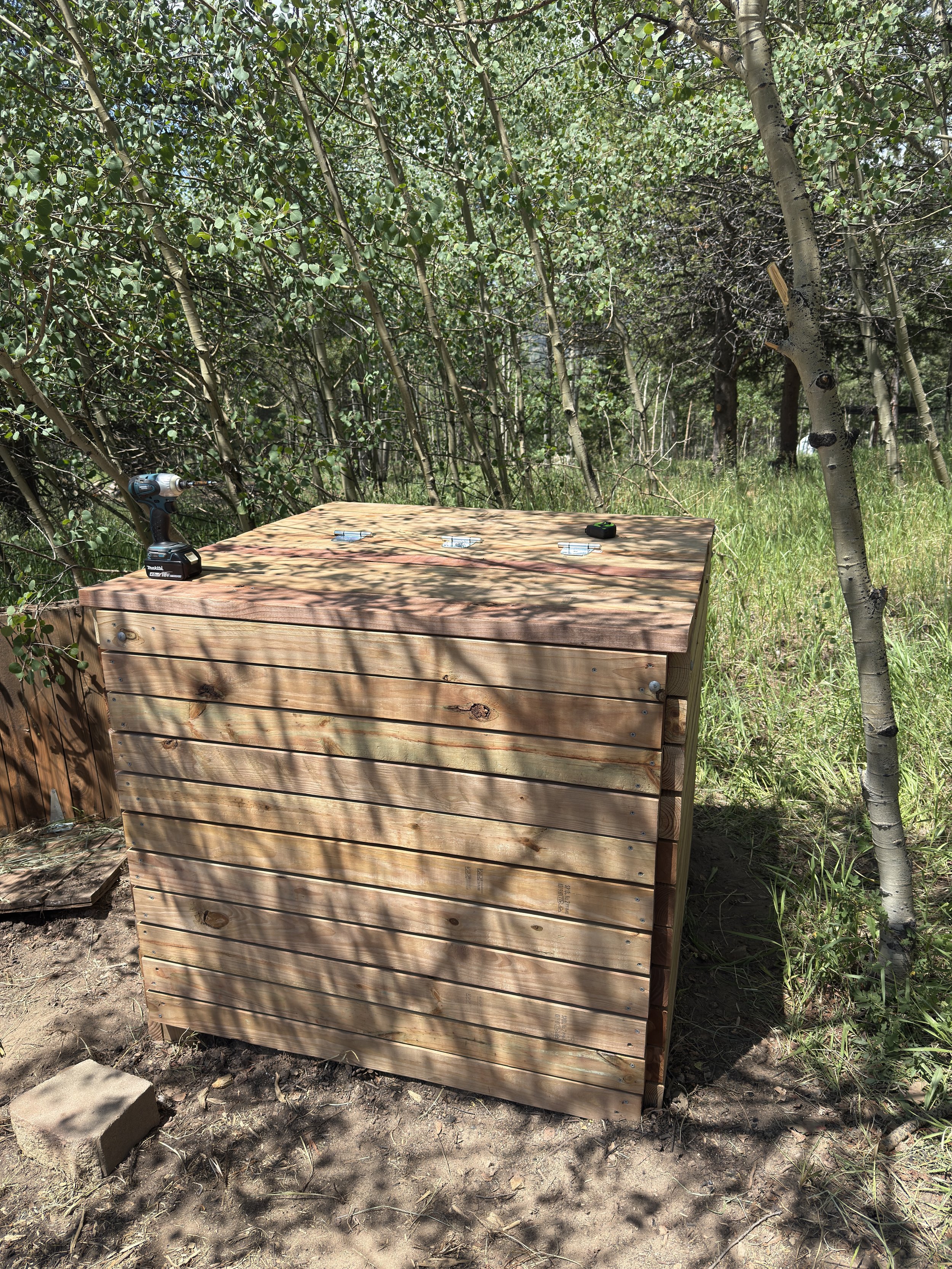
The Compost Cube
Roughly 4x4x4’, this bin avoids large gaps where bears could get their paws and claws in. The corner posts are 4x4 pressure treated lumber, and the top and bottom 2x4 slats on the outside are carriage bolted all the way through.
Beyond the Bin: Bokashi and Vermicomposting
Even a well built bin needs good management, and one piece of advice for bear country is to reduce your raw inputs.
Bokashi is a fermentation step you put all of your food scraps through before adding them to the compost bin. A bacterial inoculant is added to a bucket along with your scraps. This changes the smell profile of the scraps, but also means they break down much faster once they're in the bin. Less time in a raw form means less time bears want to eat what you've got. Processing more compost quickly also means you can potentially accept scraps more readily from neighbors or friends.
Vermicomposting is an option, too. Vermicomposting uses worms to break down food waste into what is commonly referred to as “black gold,” though really it’s mostly worm poop! Worm poop, or worm castings, are extremely high in biological value and retain even more moisture than traditional compost. Also, while you can buy them from the store, worm castings made at home that never dry out or sit on a shelf for months are better than the store bought counterparts.
The Takeaway
While it takes a little bit more time and effort, building your own bin can allow you to safely compost in bear territory while reducing the interactions between bears and people. This means you get rich, beautiful compost to throw into your garden beds and reduce your environmental footprint along the way. If you ever have questions about composting, please do reach out. Advanced composting technique workshops are coming in Spring 2027 and will cover both bokashi and vermicomposting!